An everyday situation: A patient enters your dental practice with acute pain. They examine him, make the diagnosis and immediately plan the necessary root canal treatment. After two more appointments, you can discharge the patient without symptoms and visibly relieved.
Medically, you've done everything right. But legally, you may be standing on thin ice if you have not fully documented the process. The documentation requirement for dentists may seem like an annoying task and take up a lot of time. Yet there is no way around it.
But that doesn't mean that you want to invest many hours in administrative writing tasks after practice. In this article, you will learn how you can meet the documentation requirement much faster, more efficiently and legally with the support of artificial intelligence.
What does the documentation requirement mean in a dental practice?

The documentation requirement requires you by law to keep a complete record of all medically relevant measures and results. This obligation is set out in the Civil Code (Section 630f BGB) is clearly enshrined in the Patients' Rights Act.
A medical record is mandatory
This means that as a dentist, you are required to keep a patient record on paper or electronically. This file is primarily intended to secure treatment. It ensures that colleagues or specialists can also understand at any time which treatments have been performed on a patient.
At the same time, the documentation serves as your own insurance. If a patient should complain of complications following an implantation, the file is the only objective evidence. You should therefore always remember that missing entries do not make the argument easier for you in the event of a dispute.
Who is required to provide documentation in a doctor's practice?
This legal requirement applies to all treating doctors without exception. This includes dentists, specialists, general practitioners and psychotherapists alike. As a practice owner, you are fully responsible for the accuracy and completeness of the file.
You can delegate parts of the documentation to your practice team. However, the final examination and approval is always up to you as the treating dentist. A clean documentation requirement is extremely important, especially in joint practices. An example: When you go on vacation, your representative must immediately know which medication a pain patient has received the previous day.
Which treatment steps do you have to document as a dentist?
You must take every essential step from the initial anamnesis, ideally in the form of a digital patient recording, from education to actual therapy and aftercare. A rough sketch is not enough.
The Federal Association of Statutory Health Insurance Dentists and applicable court rulings require a high level of detail. The following aspects must be included in your medical record:
- Anamnesis: The patient's previous medical conditions, allergies and current medication intake.
- Diagnostics: All findings, radiographs, models and vitality tests.
- Enlightenment: The documented patient discussion about risks, treatment alternatives and costs.
- therapy: Each treatment step carried out, medications administered and materials used, including batch numbers.
- Patient behavior: Any non-compliance on the part of the patient, such as failure to attend important check-ups.
What happens if you violate the documentation requirement?
In the event of a dispute, an incomplete patient record usually leads to a reversal of the burden of proof against you. This represents one of the biggest legal risks for you as a dentist.
An example of this: A patient demands compensation for nerve damage following a wisdom tooth removal. He claims that you did not tell him about this risk. If you have not documented the clarification in the file, the court may be able to assume that this clarification actually did not take place.
You must then prove otherwise. Without written notes, the year after treatment is virtually impossible. Clean and complete file management therefore directly protects you against unjustified recourse claims. Audit-proof workflows also increase liability security.
How much time does dental documentation take on a daily basis?
One survey The Federal Association of Statutory Health Insurance Dentists (KZBV) and the Statutory Health Insurance Dental Associations with 2,300 participants have revealed: An average dental practice has to deal with bureaucracy 24 hours a week. File maintenance therefore consumes a large part of your productive working time.
You don't have that time at the dental chair. It is missing for the personal care of your patients and for the turnover of your practice. Manually typing in reports is error-prone and tiring. Many doctors complete this documentation after work. This leads to an enormous additional burden and dissatisfaction within the practice team.
Patient consultation: The biggest time waster in documentation
Writing down a complex explanatory discussion in detail requires maximum concentration and costs valuable time. They must translate medical facts into legally secure texts.
As you talk to the patient, you want to look them in the eye and show empathy. That's hardly possible if you're typing or dictating at the same time. This massively disrupts the flow of treatment. If, on the other hand, you only write down the content hours later, rely on your memory — combined with appropriate sources of error. Important details can quickly be lost.
How does artificial intelligence make it easier to document your patient conversations?
The use of artificial intelligence for medical documentation offers many opportunities to become more efficient in your practice processes and to automatically log findings. Smart AI documentation records the spoken word in the treatment room and automatically converts it into structured report entries.
The procedure: You talk to your patients naturally. The software automatically listens. It filters out small talk and recognizes the medically relevant facts. At the end of the conversation, the AI generates a finished, structured text for your patient records. All you have to do is read this entry briefly and confirm it with one click. This saves you valuable minutes for each individual patient.
Why is Nelly's AI documentation the solution for your practice?
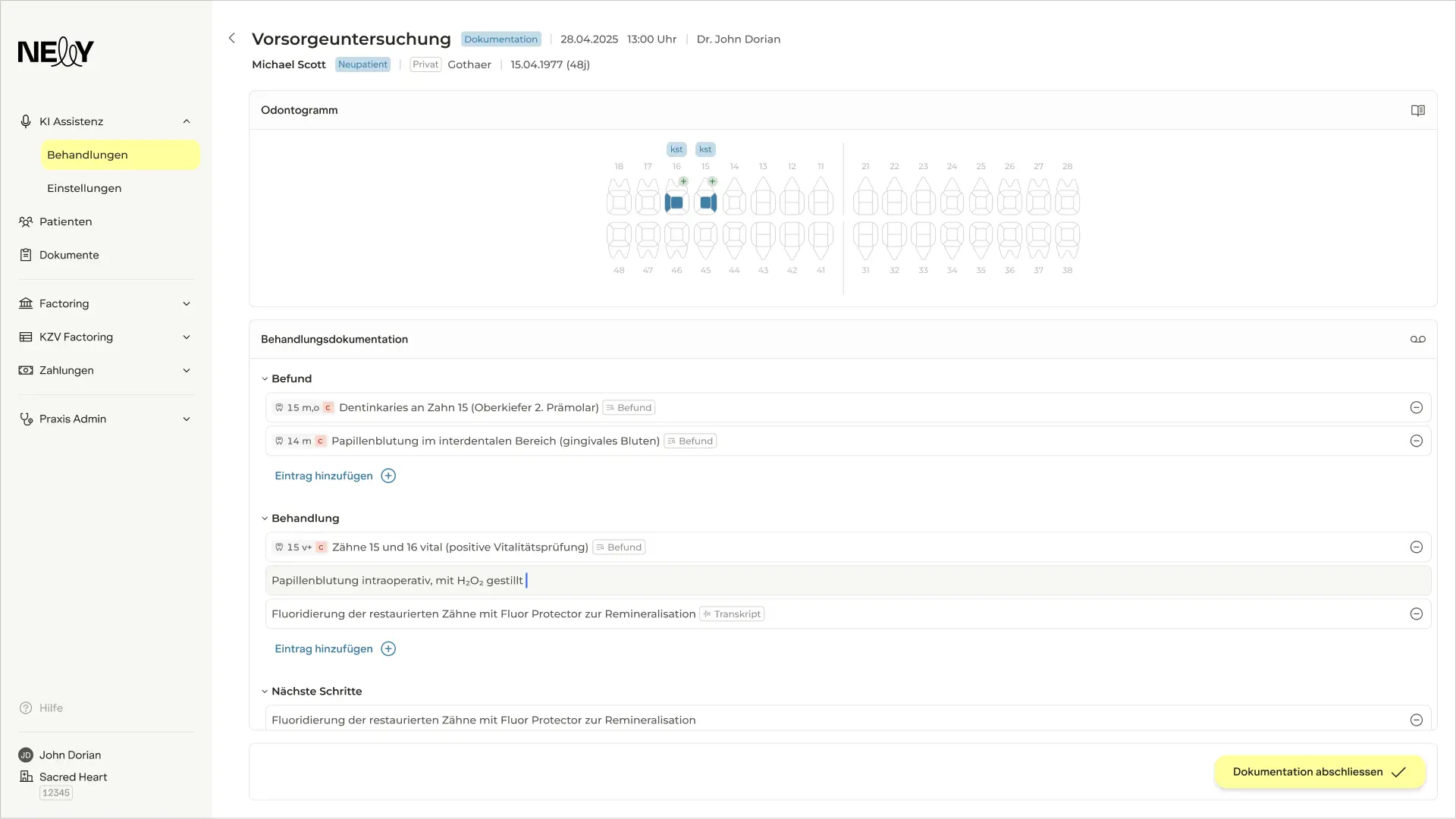
Nelly supports you with a seamless digital workflow, from documentation From patient consultation to the entire administrative and financial part. The solution, which is specifically tailored to the high requirements of dental practices, relieves you of the annoying administrative burden.
“Nelly AI is worth its weight in gold for us, as routine tasks are performed for us in the treatment room. As a result, we have perfect documentation and billing.” Dr. Tim Graf, TEETH
Since all process steps are closely interlinked, digitized and largely automated, this creates real administrative relief. They outsource the hard work to technology and at the same time retain full medical control over the content.
You can find all details about our solution right here: https://www.getnelly.de/produkte/ki-dokumentation
How do you link medical documentation with financial processes?
The medical planning is ready, as is the cost estimate. But this often results in a severe break in processes. While you may already be using AI documentation in the treatment room to optimize processes, the financial processes are often still based on analog media breaks: The treatment and cost plan is printed out, physically handed over and payment is made via manual transfer.
Managing cost estimates, prepayments and consents is not just an administrative task. It is a strategic process that has a direct impact on the profitability and legal certainty of your practice. With Nelly, you can make cost estimates, consents, and payments also digitize and automate to a large extent.
How do your patients benefit from a seamless digital file?
A smooth, digital process has a professional effect on your patients and strengthens your image. You also create trust when you can visualize treatment plans transparently on screen. Your patient feels safe and professional advice. This trust is the basis for long-term patient loyalty and a commitment to high-quality private services.
What role does audit-proof storage of your data play?
Just as AI documentation presents medical history without gaps, administrative data should also be kept in a legally secure manner. Legislators and auditors require that digital health records be forgery-proof. Any subsequent change to an entry must be transparently logged. This is the only way your documentation will retain its full evidentiary value in court.
Ensure reliable digital document archiving with quick access. A digital signature is often more secure than a paper document because it is archived in an audit-proof manner and cannot be lost.
Conclusion: The right time to digitize your documentation is now
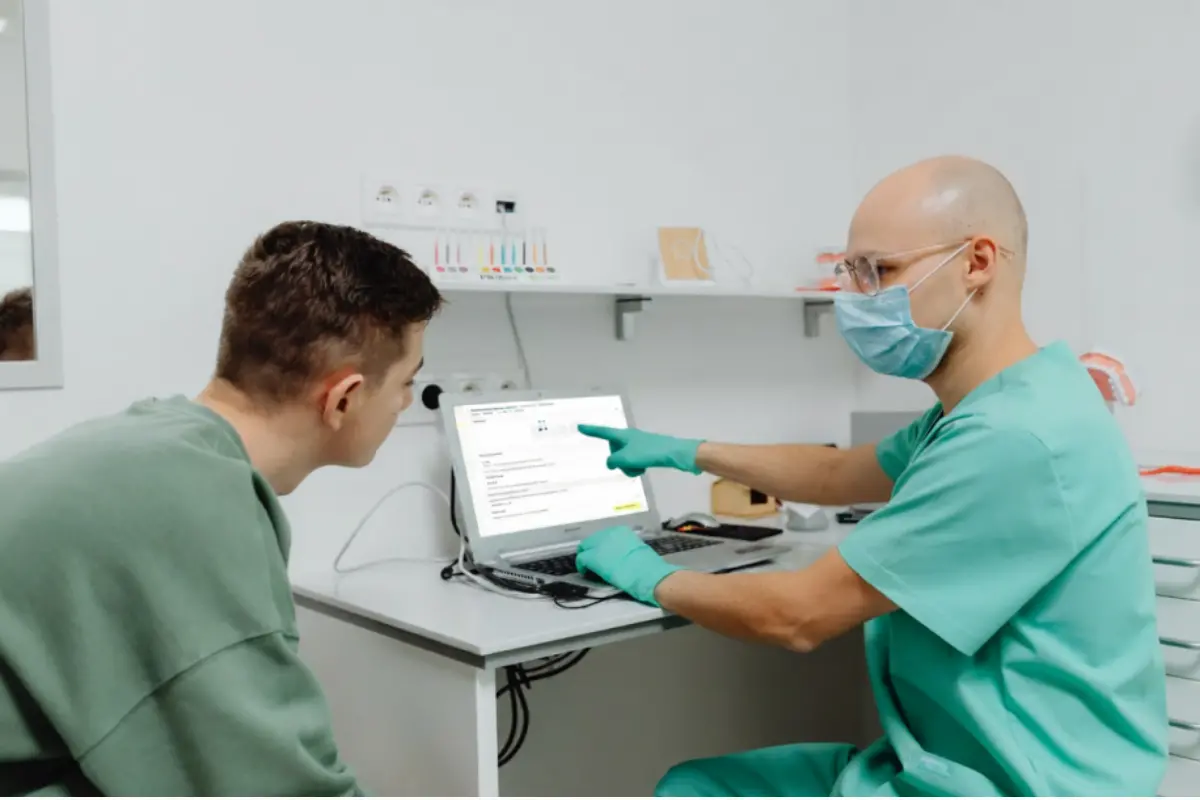
When should you start digitizing the processes in your dental practice and using AI support? The answer: right now. The administrative effort costs a lot of energy, time and resources. The legal requirements are becoming increasingly complex, and it is difficult to find specialist personnel.
With the help of digitization, you are able to map digital workflows and bring your practice management to a new level. Nelly will accompany you on this journey. In this way, you combine legal security with the enforcement of financial claims.
Your benefits: immediate more liquidity and fewer risks. Above all, you and your team will have the freedom to concentrate fully on medicine and your patients again — exactly why you chose to become a dentist.
Get information now without obligation
With Nelly, you digitalize your documentation requirements in the dental practice, optimize processes and gain sustainable efficiency. Find out more now and make an appointment for an individual consultation.
FAQs about documentation requirements in dental practices
Can I use AI and digitization for medical documentation?
Yes, using AI for medical documentation offers many opportunities to become more efficient in your practice processes and to automatically log findings. As long as the tools comply with data protection regulations and you maintain final medical control, this is absolutely legally permissible and recommended.
What are the benefits of digital, legally compliant patient consent for my practice?
Digital consent via Nelly helps you with legal protection against the patient. Another advantage: Continuous digitization of your practice workflows, from seamless, clean documentation to digital signatures, also contributes to a minimized liability risk.
What happens if I violate the documentation requirement as a dentist?
If there is no documentation for a particular measure, disputes in court are generally presumed that this measure did not take place. This so-called reversal of the burden of proof can lead to serious liability risks and claims for damages.