

The essentials at a glance
- When you use AI documentation, four areas of law apply at the same time: the GDPR, dentists’ duty of confidentiality under Section 203 of the German Criminal Code (StGB), professional law and the EU AI Act.
- A data processing agreement alone does not make you legally secure – what matters is choosing a provider that processes patient data in the EU, encrypts it and does not use it for training.
- Legal responsibility for every entry remains with you as the dentist; the AI makes a suggestion, you give the approval.
It is the end of the working day, but before you leave the practice, the day’s documentation is still waiting. You may already know what AI documentation can do: the solution captures the treatment conversation directly and creates the documentation from it – you speak instead of typing afterwards. That sounds like a real relief.
But one question still holds many practices back: is this actually compliant with data protection law and legally secure? Because the difference between a big relief and a legal risk lies solely in choosing the right partner.
Why is AI documentation in a dental practice a data protection issue at all?
Under Article 9 GDPR, health data belongs to the special categories of personal data and is subject to a general prohibition on processing with narrow exceptions. Every diagnosis, every finding and every treatment note in your practice falls under this.
As soon as an AI processes this data, it is therefore not an ordinary IT process, but the processing of highly sensitive information.
Your duty of confidentiality goes further than data protection
As a dentist, you are also bound by professional confidentiality. This protects the relationship of trust with your patients and goes further than data protection law. Anyone who uses AI documentation technically passes patient secrets on to an external service provider. This is exactly where it is decided whether that is permissible or problematic.
Why just any AI application is not enough
Just any AI application is not suitable for this. A freely available chatbot, for example, usually processes the data entered on servers that third parties can access. For your practice, this can cause four legal problems at once.
Which four areas of law do you need to consider at the same time?
When you use AI documentation, four independent areas of law apply in parallel. This is the key difference from many other practice topics. If you only think about data protection, you overlook three further levels at which a breach can become expensive.
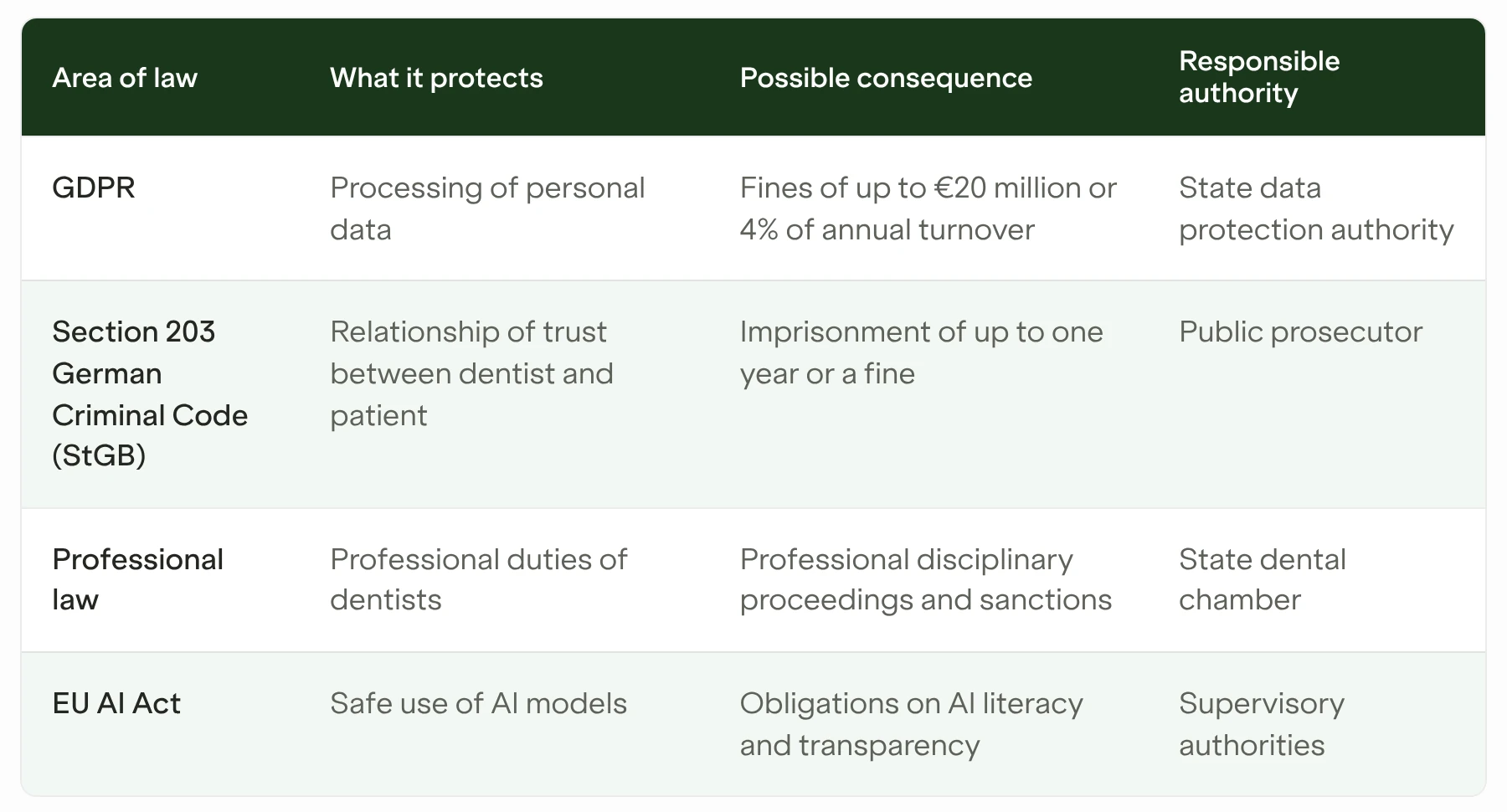
These four tracks apply independently of each other. One and the same mistake can trigger fine proceedings, a criminal complaint and chamber proceedings at the same time. The good news: with the right solution, you address all four levels at once.
Is a data processing agreement enough – and do you need your patients’ consent?
A data processing agreement (DPA) under Article 28 GDPR is mandatory for using AI documentation, but on its own it does not make you legally secure.
The DPA is mandatory – but only half the story
The DPA covers the data protection side: the provider becomes a processor who may only process your data on your instructions, while your practice remains the controller. However, a DPA only addresses data protection law, not criminal law. Dentists’ duty of confidentiality under Section 203 StGB cannot be overridden by a contract between the practice and a service provider.
A rule that has applied since 2017 helps here: Section 203 (3) StGB allows external service providers to be involved as contributing persons. The condition is that the service provider remains limited to a specific assignment and is expressly bound to confidentiality. So make sure your DPA also includes an obligation of confidentiality under Section 203 StGB.
Do you need your patients’ consent?
For the documentation itself, consent is usually not the decisive lever. Processing health data for the purpose of treatment is based on Article 9 (2) (h) GDPR in conjunction with Section 22 of the German Federal Data Protection Act (BDSG) and the treatment contract. Separate consent is not mandatory for this. As the sole solution for the duty of confidentiality, consent is even tricky, because the treatment relationship involves an imbalance of power that makes voluntariness open to challenge.
The clean legal solution therefore lies with the provider, not with the consent form. You should still inform your patients transparently and give them a choice. With Nelly, you can switch off AI documentation for individual patients: if someone does not want the AI to run during treatment, you can see this before the treatment and document manually as usual. This way, you respect patient autonomy without disrupting the workflow in your practice.
How can you tell whether an AI documentation solution is GDPR-compliant?
You can recognise legally secure AI documentation by a short list of clear criteria. Instead of relying on the label “GDPR-compliant”, you can ask specific questions. These points should be met:
- Data processing in the EU: Patient data is processed and stored exclusively on servers in the EU. Encryption in transit (TLS) and at rest (AES) is a must.
- No use for AI training: Your data is not used to train a general AI. Audio recordings are deleted after transcription.
- DPA with a confidentiality clause: The contract meets Article 28 GDPR and reflects the obligation under Section 203 StGB.
- Strict access controls: Multi-factor authentication and role-based permissions prevent unauthorised access.
- Verified security: External audits and certifications demonstrate the level of protection.
How Nelly meets these criteria
This is exactly where Nelly’s AI Documentation comes in. The solution is GDPR-compliant and TÜV-certified. Nelly processes data on servers within the EU and relies on comprehensive technical and organisational safeguards – including encryption, strict access concepts and contractual data protection agreements. In this way, we help dental practices implement digital processes in line with high European data protection standards.
Audio data is only processed temporarily for transcription and then deleted; voice recordings are not stored permanently. The data is also not used to train a general AI with sensitive patient data. This keeps your duty of confidentiality intact.
Learn more about how Nelly protects data here: https://www.getnelly.de/wie-nelly-daten-schuetzt
What does the EU AI Act mean for your practice in concrete terms?
The EU AI Act has been in force since August 2024 and is taking effect in stages. In July 2026, the EU amended it with the “Digital Omnibus” reform package: amending Regulation (EU) 2026/1744 has applied since 27 July 2026. Two obligations already affect your practice today, and more will follow in the coming years.
What already applies today: AI literacy and transparency
The AI literacy obligation under Article 4 has applied since 2 February 2025. The Digital Omnibus has reworded it: anyone who uses an AI system in the practice must take measures to promote the AI literacy of their team. The law no longer prescribes a specific level of competence. In concrete terms, this means that you and your team should be trained in using the solution you have chosen and understand how it works, its limits and its risks.
Since 2 August 2026, the transparency obligations under Article 50 have also applied, for example on labelling AI-generated content.
What comes later – and what it means for you
The Digital Omnibus has postponed the extensive obligations for so-called high-risk systems: for stand-alone systems under Annex III to 2 December 2027, and for systems embedded in medical devices under Annex I to 2 August 2028. These deadlines have been binding since July 2026.
Whether AI documentation should be classified as a high-risk system at all has not yet been conclusively clarified in law. For your practice, two things matter above all: build AI literacy in your team now, and make sure that final control always lies with a human. Both are good practice anyway and will make things easier for you as further deadlines approach.
Who is responsible if AI documentation makes a mistake?
Legal responsibility for every documentation entry always remains with you as the treating dentist. AI is a tool, not a decision-maker.
The AI suggests, you decide
Section 630a of the German Civil Code (BGB) requires treatment in line with professional standards, and the documentation obligation under Section 630f remains your duty. If you adopt an incorrect entry without checking it, you are liable for it, not the software. This leads to a simple but central rule: the AI suggests, you confirm.
How Nelly’s AI Documentation is built
Nelly’s AI Documentation is built on exactly this principle. It documents the treatment in real time in the background, recognises the medically relevant content and creates a structured suggestion without making any medical assessment. Before anything is transferred to the patient record, you review and confirm the entry. This combines time savings with full control and at the same time meets the requirement for human oversight.
Learn more here: https://www.getnelly.de/en/ai-assistance#ki-dokumentation
Which organisational steps should you take now?
Legal security comes not only from technology, but also from good organisation in your practice. The following steps lay the foundation for compliant use:
- Conclude a DPA with a confidentiality clause: The contract meets Article 28 GDPR and includes the obligation under Section 203 StGB.
- Involve your data protection officer: If your practice has or needs a data protection officer, they should be involved from the start.
- Document the processing activity: Add AI documentation to your record of processing activities under Article 30 GDPR.
- Check whether a data protection impact assessment is needed: Systematic processing of health data by AI may require an impact assessment under Article 35 GDPR.
- Train your team: Promote your team’s AI literacy with training on how to use the specific solution.
- Inform patients transparently: Let your patients know that AI supports the documentation.
Patient transparency without extra effort
The last point in particular is easy to build into everyday practice. With Nelly, patients already agree to the documentation as part of the digital medical history form, which also contains the privacy policy. This ensures transparency from the start without extra work for your team, and your patients gain trust instead of feeling processed.
Conclusion: Legal security is a question of choosing the right solution
AI documentation in the dental practice is no longer a question for the future, but a concrete relief in everyday work. What matters is not whether you use AI, but how. If you choose an unsuitable application, you risk trouble on four levels at once. If, on the other hand, you choose a solution that processes data in encrypted form in the EU, does not use it for training and leaves final control with you, you document in a legally secure way and gain time back at the same time. The technology is there – it just has to be chosen correctly.
Get informed now – with no obligation
Would you like to see what GDPR-compliant AI documentation looks like in your practice? Book a no-obligation consultation and let us show you how to document securely and with peace of mind.
FAQs about GDPR-compliant AI documentation
Is AI documentation allowed in a dental practice at all?
Yes, provided you use a suitable solution. Processing data for the purpose of documentation is covered by the treatment contract. What matters is data processing in the EU, a data processing agreement with a confidentiality clause and final control by you.
Is a data processing agreement enough for legal security?
No. A DPA under Article 28 GDPR covers data protection law, not the criminal-law duty of confidentiality under Section 203 StGB. The contract must also include an obligation on the provider to maintain confidentiality. Only then are both areas of law properly covered.
Do my patients have to consent to AI documentation?
Separate consent is usually not mandatory for documentation, as it is based on the treatment contract. Informing your patients transparently is still important and builds trust. It can easily be built into the digital medical history form.