
The essentials at a glance
- Towards the patient, you as the practitioner are liable, because AI is not a legal entity and the treatment contract is with you, not with the provider.
- Review every AI draft promptly and specifically at the points relevant to liability, such as tooth numbers, informed consent and medication, before you approve it.
- With your approval, the draft becomes your documentation, which works as evidence in your favour in a dispute if it is correct, complete and timely.
Two years after extracting tooth 38, a patient accuses you of not having informed him about the risk of nerve damage. Since the procedure, he has complained of numbness in his lower lip. You open the record. It says: “Patient informed about risk of injury to the inferior alveolar nerve.”
Medically, you did everything right. But one question remains: did you actually say it like that at the time? Or did the AI documentation turn two half-sentences into a complete consent discussion that you confirmed with one click at the end of a long day?
This is exactly where it is decided whether AI documentation protects you or leaves you exposed. And the answer does not lie with the AI, but with you.
Who is legally liable if AI documentation is incorrect?
Towards the patient, you as the practitioner are liable – regardless of whether you wrote, dictated or used AI. Under Section 630a of the German Civil Code (BGB), the treatment contract is between you and your patient. AI is not a legal entity; it can neither be a contracting party nor be held liable.
The standard remains the same: you owe treatment in line with generally accepted professional standards. Which tool you use does not change this standard.
However, there is an important distinction that often gets lost in the discussion: a documentation error is not in itself a separate basis for liability. Damages are only at stake if you have breached your duties of treatment or informed consent. Incorrect AI documentation therefore becomes dangerous in two ways:
- As a problem of proof: Under Section 630h (3) BGB, anything that is not documented is presumed not to have been done. You can read in detail how these rules of evidence apply in practice in our article Accused of a treatment error: How does your documentation protect you?
- As a knock-on error: An incorrect entry – such as an overlooked allergy or a mixed-up tooth – can steer a later treatment decision in the wrong direction. In that case, the treatment error is not in the record, but in the treatment chair.
Isn’t the AI provider also liable?
Yes, possibly in addition. But that does not change who your patient turns to. They sue you, not the software manufacturer. Whether you can then recover your losses from the provider is a matter for your contract and product liability law.
There is no separate AI liability law: the EU Commission withdrew its draft AI Liability Directive in February 2025. Instead, change is coming through product liability law. The new EU Product Liability Directive must be transposed into German law by 9 December 2026 and explicitly classifies software as a product. It applies to products placed on the market from that date.
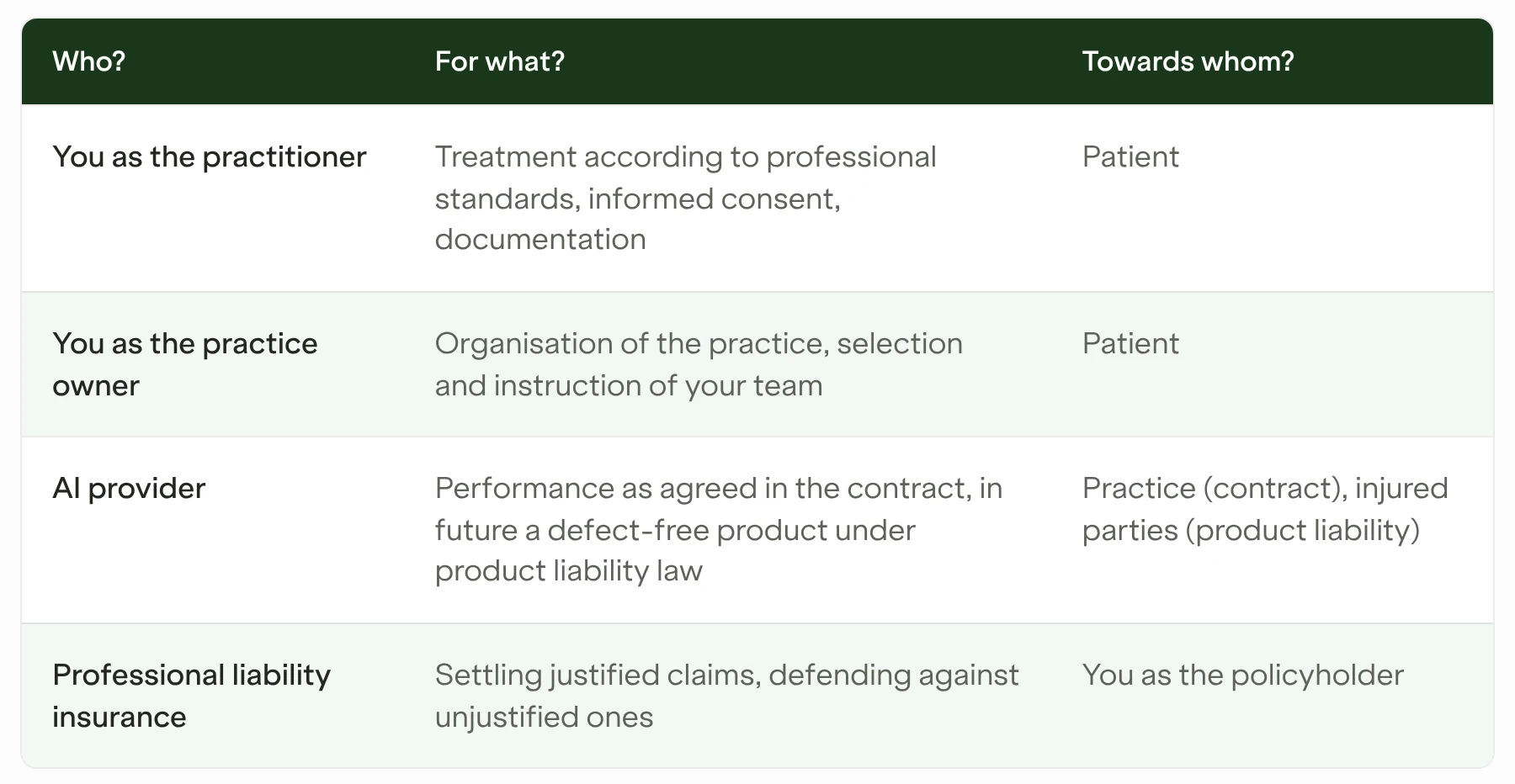
In short: tasks can be delegated to AI. Your responsibility towards the patient cannot.
What errors does AI make in documentation, and which ones become relevant to liability?
AI errors become relevant to liability where they distort a statement about your treatment or informed consent – while sounding plausible enough to go unnoticed during approval. Not every error carries the same risk. A typo in the running text is annoying; a mixed-up quadrant can steer follow-up treatment to the wrong tooth.
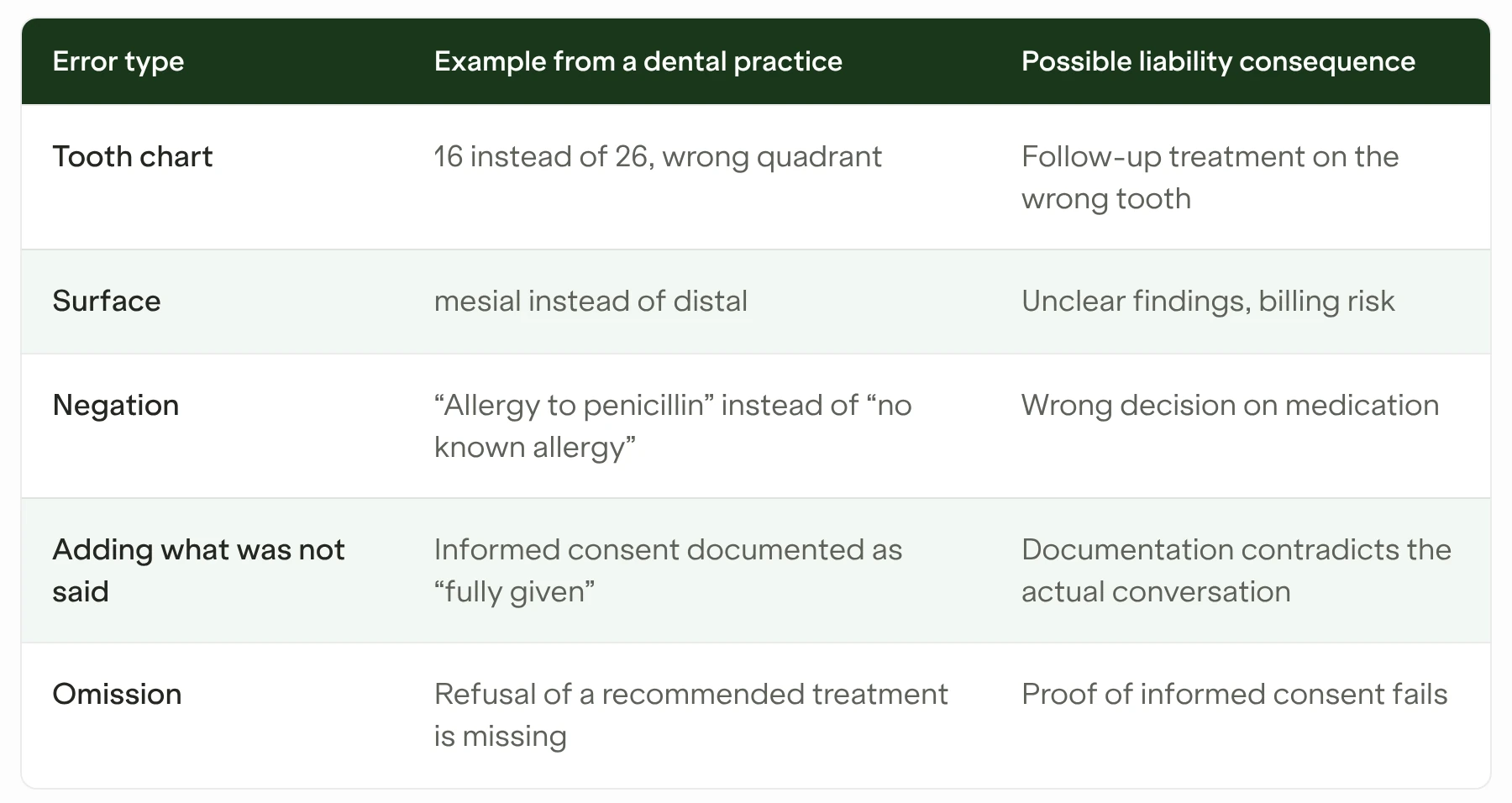
The last row deserves special attention. AI can only record what was said in the room. What you do not say out loud will be missing from the draft. At the same time, the second-to-last row is the most insidious: an entry that claims more than actually happened even looks better at first glance.
There is also a human factor. The more reliable a system seems in everyday use, the faster drafts get waved through. This so-called automation bias is not a sign of carelessness – it is human. That is exactly why a fixed review step is needed.
Why is the approval step not a problem but your safeguard?
The approval step is the moment an AI draft becomes your documentation – and therefore your evidence. Without a review, your liability would be exactly the same. It would just be uncontrolled.
Many practice owners initially see the review as a contradiction: why use AI if you have to read everything in the end anyway? This view misjudges where time is actually lost. The AI takes over the wording, structuring and typing. What remains is the part that only you can do anyway: the professional confirmation.
Timing also plays a decisive role. Under Section 630f (1) BGB, changes to the patient record must be made in such a way that the original content and the time of the change remain recognisable. In 2021, the German Federal Court of Justice (BGH) clarified that electronic documentation without a traceable change history loses its evidential value (BGH, judgment of 27 April 2021 – VI ZR 84/19). The rule is therefore: review thoroughly before approval instead of correcting entries later.
This is where Nelly’s AI Documentation comes in. Nelly listens during the patient conversation, filters out the medically relevant content and presents you with a structured draft. No medical analysis or assessment takes place. You review the draft, add to it if necessary and confirm it. Only after your approval does the documentation go into your practice management system. This keeps responsibility where it legally belongs – and takes the writing off your hands.
Learn more here: https://www.getnelly.de/en/ai-assistance#ki-dokumentation
How can you review AI drafts quickly without losing the time savings?
Reviewing efficiently does not mean reading every sentence twice, but checking the points relevant to liability in a targeted way. With a fixed routine, approving a typical entry takes less than a minute. These five steps have proven effective:
- Approve drafts on the same day: Right after treatment, you still remember the conversation clearly. A week later, you are only checking whether the text sounds plausible – and that is not enough.
- Check the risk points first: Tooth numbers, surfaces, allergies and medication, informed consent content and refused treatments. These details decide a dispute, not the wording of the running text.
- Do not confirm anything you did not say: If the draft contains a consent discussion that did not take place in that form, delete or correct it. Documentation that is too good is just as vulnerable in a dispute as documentation with gaps.
- Actively fill gaps: AI cannot record what was not said. Get into the habit of saying important points out loud in the treatment chair – for example, “Patient refuses implant, alternatives discussed”.
- Keep approval with the practitioner: Your team can support you with many documentation tasks. However, the professional confirmation of your own treatment should remain with you.
What should you safeguard organisationally as a practice owner?
As a practice owner, the best way to safeguard the use of AI is through clear rules, a trained team and reviewed contracts. This not only protects you in the event of a liability claim, but also gives your team confidence. These points belong on your list:
- Internal AI policy: Set out in writing who approves AI drafts, what needs to be checked before approval and by when. One page is enough.
- AI literacy in the team: The EU AI Act requires your staff to be competent in handling AI systems. You can read what currently applies in our article AI literacy under Article 4. You will find the overall legal framework under What does the EU AI Act mean for your practice?
- Patient information: Inform your patients transparently that AI supports documentation, and respect any objection.
- Professional liability insurance: Ask your insurer whether AI-supported documentation is covered by your policy, and get the answer in writing.
- Contract with the provider: Look for a data processing agreement, data processing within the EU and clear liability provisions.
Here, too, Nelly takes some of the work off your hands. If a patient does not want their conversation to be captured by the AI, you can see this before the appointment. Your team therefore does not have to improvise in the treatment room. You can read how Nelly protects your patients’ data on the page How is data protected at Nelly?
Learn more here: https://www.getnelly.de/wie-nelly-daten-schuetzt
Conclusion: Your approval is not a formality but your safeguard
The liability question does not speak against AI documentation, but in favour of handling it properly. You are liable towards your patients anyway – whether you write, dictate or use AI. The difference lies in whether you consciously take on your responsibility. With a fixed approval routine, you turn an AI draft into documentation that works for you in a dispute. And the time you gain belongs to your patients again.
Get informed now – with no obligation
Would you like to see how review and approval work in Nelly’s AI Documentation in everyday practice? Book a free consultation here.
FAQs about liability for AI documentation
Is the AI provider liable if the documentation is wrong?
Towards your patient, you as the practitioner are liable, because the treatment contract is with you. The provider may also be liable – for example under your contract with them or, in future, under the new product liability law, which covers software as a product from December 2026. However, this concerns your relationship with the provider, not your liability towards the patient.
Do I have to read every AI draft in full?
You have to review every draft before you approve it, because with your approval it becomes your documentation. This works efficiently if you specifically check the points relevant to liability: tooth numbers, surfaces, allergies and medication, informed consent content and refused treatments. Ideally, review on the same day.
Does my professional liability insurance cover errors from AI documentation?
As a rule, it is your work as a dentist that is insured, not a specific tool. However, whether your policy explicitly includes AI-supported processes or contains restrictions differs from policy to policy. Ask your insurer and get the answer confirmed in writing.