
The essentials at a glance
- Today, the value of a dental practice is mainly measured by the transferable earnings that a successor can expect to generate after the handover.
- If you organise documentation, processes and the follow-up of treatment plans independently of yourself, you increase these transferable earnings and with them the goodwill.
- As valuers usually look at the results of the last three years, measures that increase value should take effect no later than three years before the planned sale.
A young dentist sits across from you, leafing through your sales brochure. Revenue, patient numbers, equipment – everything is convincing. Then she asks the one question that decides the price: “How much of this retires with you?”
Many practice owners have no good answer. Knowledge about ongoing treatments is in their own head, open treatment plans are only followed up when they remember, and documentation gets done in the evening after hours. Medically, your practice is in excellent shape. Economically, it is a risk for a buyer.
How is the value of a dental practice determined?
The value of a dental practice is made up of the net asset value and the intangible value, known as goodwill. The net asset value covers furnishings, treatment units, equipment and IT. Goodwill reflects what the practice is worth beyond its equipment: patient base, location, team and earning power.
There is no valuation method prescribed by law. However, the modified capitalised earnings method has become established. In 2011, the German Federal Court of Justice (BGH) clarified for the valuation of a dental practice that an individual owner's salary must be deducted (case no. XII ZR 40/09). In the same year, the German Federal Social Court (BSG) recognised the modified capitalised earnings method as suitable (case no. B 6 KA 39/10).
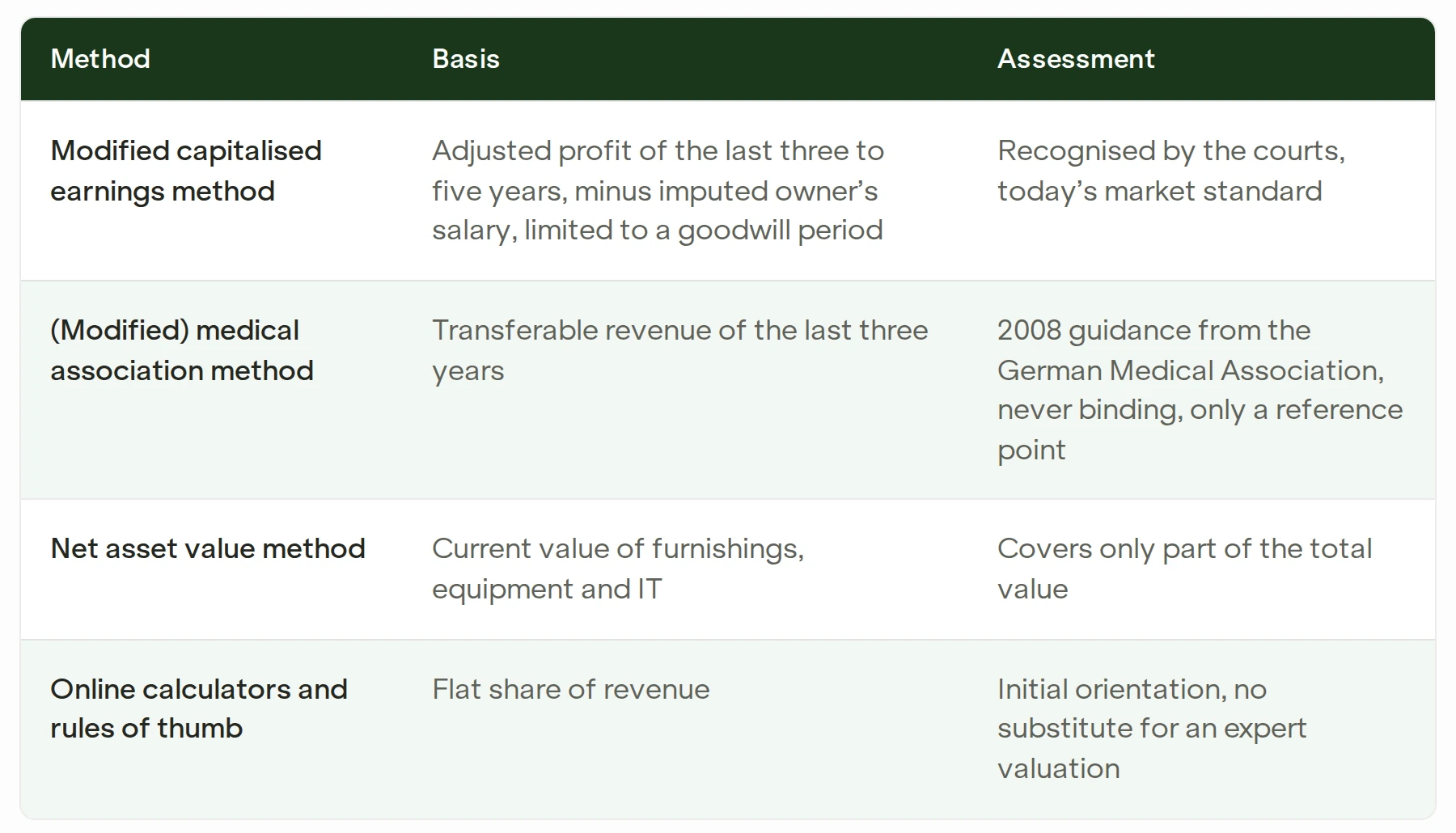
What matters is the so-called goodwill period. It describes how long previous earnings are expected to last after the handover and is usually between two and five years. The longer your patients and your earnings stay without you, the higher the goodwill.
Why does owner dependency lower the price of your practice?
Owner dependency reduces the value of a practice because the buyer only pays for the earnings that remain transferable after you leave. If patient loyalty, treatment knowledge and revenue management depend on you personally, a valuer will assume a shorter goodwill period. Your patients trust you. That is your greatest asset – and your greatest risk when you sell.
At the same time, the market has become more demanding for sellers. According to analyses by apoBank, purchase prices for dental practices fell by around nine per cent in 2024, to an average of about 226,000 euros. The Institute of German Dentists (IDZ) also points to an oversupply of practices for sale.
There is also a special feature of dentistry in Germany: since 2007, there have been no restrictions on licences for dentists. A successor therefore does not have to take over your practice to set up on their own. They can just as easily found a new practice or buy another one. Your practice is therefore competing not only with other offers, but also with the option of starting from scratch.
This leads to a clear task: you need to be able to show that your practice works without you.
How does AI documentation increase the transferable value of your practice?
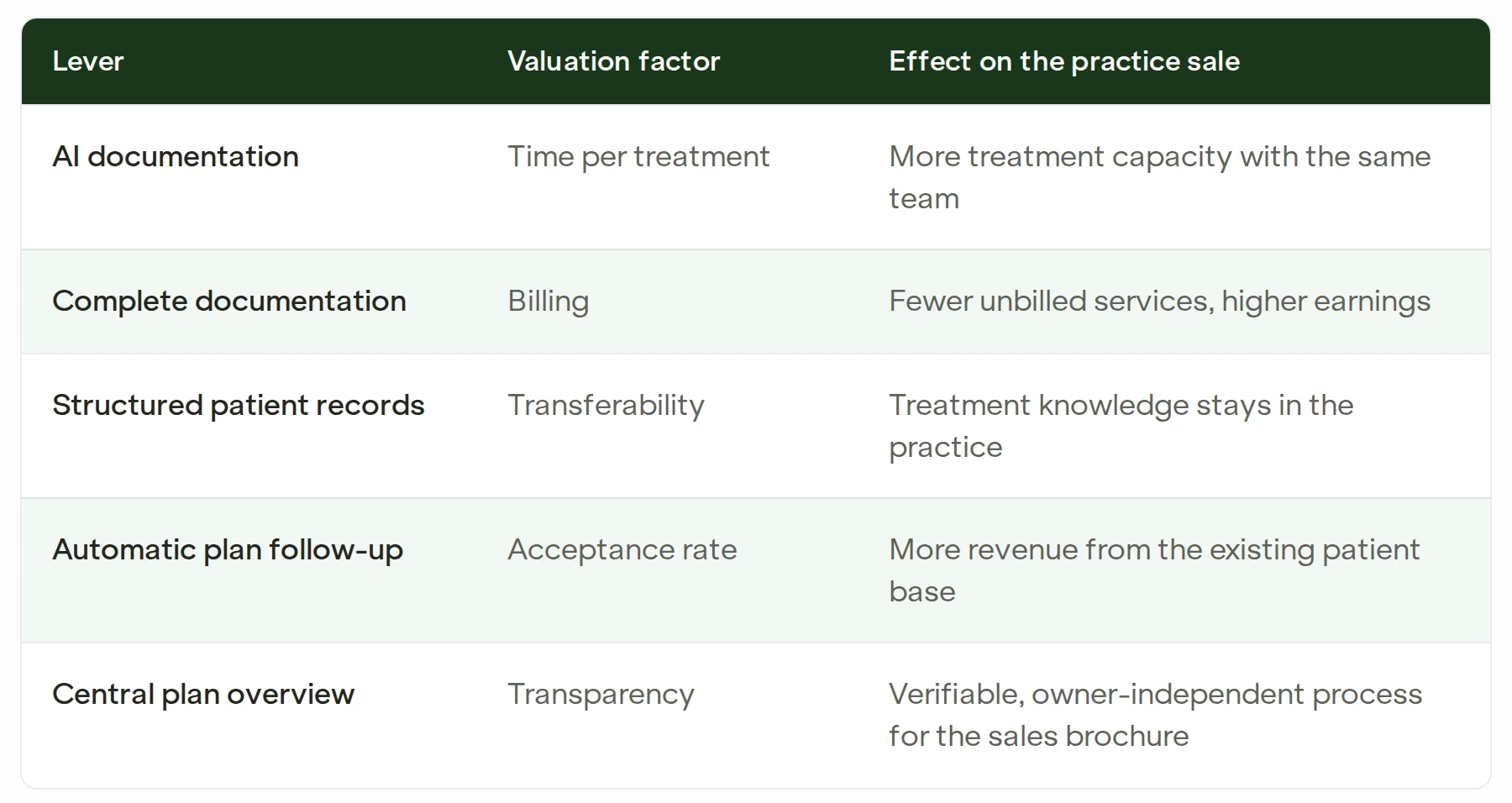
AI documentation increases transferable value because it records treatment knowledge completely and in a structured way in the patient record instead of in the owner's memory. At the same time, it reduces the time spent per treatment and ensures that all services provided can be billed. Both have a direct effect on the factors a valuer assesses.
Where does your practice lose earnings through documentation today?
In many dental practices, documentation is done under time pressure: notes between two patients, additions in the evening, details from memory. This costs you twice. First, you lose this time in the treatment chair. Second, revenue is lost when services are not fully documented and therefore not billed.
When selling your practice, there is a third point. Your successor will continue working with your records after the handover. Incomplete entries mean extra work for them to reconstruct ongoing treatments. Complete, consistently structured documentation, on the other hand, shows that your practice's knowledge is transferable.
How does Nelly take the load off your documentation?
This is where Nelly's AI Documentation comes in. The solution listens in the background during the patient conversation, recognises the medically relevant content and discards everything else. You receive a draft documentation that you review and confirm. No more dictating or writing up afterwards.
Based on Nelly's experience, practices save up to 40 per cent of their time through automated documentation and plan follow-up. This time is available for treatments – and therefore for exactly the earnings that determine your practice value.
“The Nelly AI is worth its weight in gold for us, because it takes routine tasks off our hands in the treatment room. As a result, our documentation and billing are perfect.”
– Dr Tim Graf, ZÄHNE
Learn more here: https://www.getnelly.de/en/ai-assistance#ki-dokumentation
How do accepted treatment plans increase your practice value?
Accepted treatment plans increase the value of a practice because they raise revenue from the existing patient base without you having to win new patients. This additional revenue feeds into the earnings years that a valuer takes into account. Every treatment plan left in the drawer is revenue you have already earned but not realised.
Why do so many treatment plans go unanswered?
You create a treatment plan for an implant and crown, explain the costs, and the patient wants to “think about it”. After that, you hear nothing. Following up often falls by the wayside in everyday practice because your reception team is fully stretched. On top of that, many patients simply do not understand their treatment and cost plan and hesitate as a result.
For a buyer, this is a warning sign. A low acceptance rate shows them that potential is going unused. And if follow-up depends on you alone, it is not secured after the handover.
How does Nelly automate follow-up?
Nelly's AI Treatment Plan Agent takes treatment plans directly from your practice management system and creates an easy-to-understand summary of each plan for the patient. Patients can sign the plan digitally and choose how to pay, including payment in instalments via partner providers. The solution automatically reminds patients of open plans at set intervals by email, SMS or WhatsApp. Your team stays in control and can take over personally at any time.
Based on our experience, practices accept up to 20 per cent more treatment plans this way. Together with complete documentation, the additional revenue can be put at around 18,000 euros per practitioner.
Learn more here: https://www.getnelly.de/en/ai-assistance#ki-plan-agent
How do AI solutions affect the valuation factors?
What other factors influence the value of a practice?
Besides documentation and treatment plans, the value of your dental practice is mainly influenced by your team, patient structure, range of services, equipment and lease. Buyers examine these factors closely because they determine how stable earnings remain after the handover.
- Team: A well-established team with qualified dental assistants, prophylaxis assistants or dental hygienists keeps processes and patient loyalty secure beyond the handover.
- Patient structure: A balanced age mix and a working recall system make the patient base attractive to younger buyers.
- Share of private services: Services such as professional teeth cleaning, high-quality prosthetics or implantology billed privately strengthen earning power regardless of budget limits.
- Equipment: A backlog of investment in treatment units, X-ray or intraoral scanners lowers the price because the buyer factors it in.
- Lease: A sufficient remaining term and the option to transfer the lease to the successor are key for banks and buyers.
First impressions count too. When patients complete their medical history digitally on their smartphone before the appointment and the data goes straight into your practice management system, this noticeably eases the load on your reception. Nelly's digital patient intake also shows a buyer that your practice is already organised where they would have to take it anyway.
Learn more here: https://www.getnelly.de/en/patient-intake
When should you start preparing to sell your practice?
You should start preparing to sell your practice three to five years before the planned handover. Valuers usually look at the results of the last three years and give more weight to the most recent ones. Measures you only put in place in the year of sale will hardly show up in these figures.
- Five years before: Assess your starting point. Have the value of your practice determined by an expert. This shows you early on where earnings are being lost and where an investment backlog is building up.
- Three years before: Make processes independent. Introduce digital documentation and structured follow-up of treatment plans. The results will then be fully reflected in the years relevant to the valuation.
- One to two years before: Prepare the handover. Clarify the lease and staffing questions and create a sales brochure. Advertise through the practice exchanges of the regional dental associations, dental chambers and dental suppliers. If you would like to reduce your hours gradually, our article on working part-time as a self-employed dentist describes a possible transition model.
- In the year of sale: Settle records and contract. You may only hand over patient records to your successor with the patients' consent. Without consent, they must be stored separately. Settle this in the contract, as well as any transition period in which you continue to work.
Conclusion: The value of your practice is created years before the sale
When you sell your practice, your successor pays for the earnings that continue without you. The less these earnings depend on you personally, the higher the goodwill. Complete documentation and consistently accepted treatment plans are two of the most effective levers for this. So start early – so that you feel the results not only in everyday practice, but also in the sale price.
Get informed now – with no obligation
Find out in a free consultation how Nelly takes the load off your documentation and treatment planning and gets your practice ready for the handover.
FAQs about selling your practice
How is the value of a dental practice calculated?
The value of a practice is made up of the net asset value and goodwill. The modified capitalised earnings method, which the German Federal Social Court recognised as suitable in 2011, is considered the market standard. It is based on the adjusted profit of recent years minus an imputed owner's salary and limits this to a goodwill period of usually two to five years.
When should I start preparing to sell my practice?
Ideally three to five years before the planned handover. Valuers usually look at the results of the last three years. Measures to increase value, such as digital documentation or better acceptance of treatment plans, therefore need to take effect in good time to be reflected in the sale price.
Does digitalisation increase the value of a dental practice?
Yes, if it increases transferable earnings. AI documentation reduces time spent and ensures complete billing. Automated follow-up of treatment plans increases the acceptance rate. Both make earnings less dependent on the owner – and it is exactly this independence that a buyer pays for.