What are the benefits of paying by card for my doctor's office?
Card payments in your doctor's office offer a number of attractive benefits — both for your patients and for your practice team and beyond:
- Patient comfort: Whether it's an EC card, credit card or contactless payment via smartphone — patients pay as they are used to in their everyday lives. This increases satisfaction and service quality in your practice.
- Real-time transaction confirmation: Transactions are confirmed within a few seconds. You can always be sure that your fee will arrive safely.
- Time and cost savings for your practice team: The error-prone reconciliation of Invoices with incoming payments are no longer necessary, as is the sending of reminders. Additional reminder costs are a thing of the past.
- Simplified accounting: You always have an overview of your additional income for health benefits. Thanks to individual data exports, tax advisors can easily further process the data.
- Improved liquidity: Card payments are credited to your practice account within one to two working days. This ensures predictable income and a secure financial position.
- Reduced cash handling: No need for large amounts of change, no cash book and no need to deposit money at the bank anymore. This saves time, minimizes risks and makes cash payments almost superfluous.
- Hygienic payment process: Less cash contact means fewer germs, viruses and bacteria. Especially in a medical practice, this is an advantage for patient safety and the practice team.
How does card payment work in a doctor's office?
Card payments are uncomplicated and can be seamlessly integrated into everyday practice. Your patients and medical professionals benefit equally from a clearly structured process.
This is how card payment works for your patients
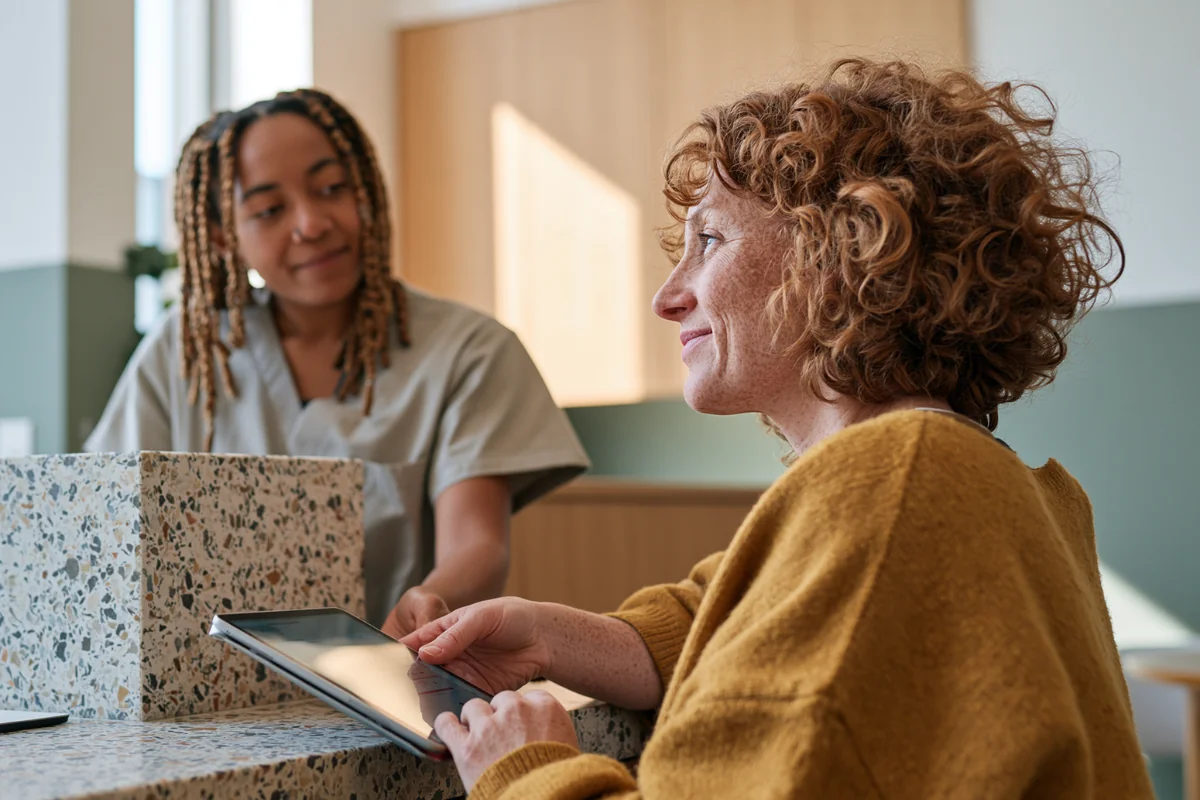
After treatment, patients can Amount directly via card reader Pay — either traditionally with an EC or credit card, contactlessly by card or via NFC-enabled smartphones and smartwatches with services such as Apple Pay or Google Pay.
Within a few seconds, the system checks the transaction, confirms receipt and immediately assures the patient that everything has been completed. An additional advantage: The integrated receipt printer prints a payment receipt that the patient can take home directly.
This is how card payment works for your practice team
The process is also seamless for your practice team, especially when you work with Nelly. Once the payment is made, it is automatically processed in Nelly Praxisportal displayed. All transaction data is available there in real time, so that your team always has an overview of the amounts received.
All amounts are posted to your practice account within one to two working days — orderly, transparent and without additional banking channels.
What costs does my doctor's practice incur for card payments?
Basically, there are two types of costs for card payments: one Fee per transaction and possible fixed costs for the card reader. Many providers combine both in a complex list of services, which is often difficult for practices to understand.
It's different with Nelly. For payments with EC, debit and credit cards as well as for Apple Pay or Google Pay via our card terminals, there is only a transparent fee of 0.99% per transaction on. You only pay when there is actually a turnover.
Are there any monthly fees for the card reader?
Some payment processors charge a monthly fee for the card reader provided. For medical practices, this means additional fixed costs, regardless of whether card payments are made or not.
With Nelly, you accept card payments flexibly and without obligation to accept them. You pay a monthly device rent per terminal as well as transparent transaction fees. Depending on the practice profile, there may be optional fixed fees per transaction. Individual packages include 1-2 devices.
Which card reader is best for card payments?
For everyday use in a doctor's practice, card terminals are particularly suitable, which both stationary as well as mobile can be used. A powerful battery provides flexibility, and an easy-to-read display makes it easy to use.
Die Card readers from Nelly combine both: They have a rechargeable 5,840 mAh (21.3 Wh) battery for mobile use and can be flexibly connected thanks to Ethernet, mobile communications, Wi-Fi and Bluetooth. Payments are also possible when operating offline. that 5.5 inch touch display makes use particularly convenient and user-friendly.
Which payment methods are accepted?
Which means of payment are accepted usually depends on the bank that is the contracting party. At Nelly, we work with the Volks- und Raiffeisenbank.
This gives your patients the freedom of choice: You can classically with EC, debit or credit card pay or contactlessly with an NFC-enabled smartphone via modern payment services such as Apple Pay and Google Pay. The card terminal thus covers all common payment methods and ensures that every patient finds a suitable option.
What alternatives are there to paying by card reader?
In addition to the card reader and conventional methods such as bank transfer, SEPA direct debit or cash payment, there are other modern payment options for medical practices:
- Online payment/payment links: With payment links via e-mail, patients can pay via smartphone or at home on a PC — as convenient as when shopping online. Find out more about online payment with Nelly.
- Installment models: In the case of recurring services (e.g. therapies), patients can be relieved through installment payments. Nelly also offers for this model as part of Factoring for doctors Options on.
- Tap to pay: With this function, the smartphone itself becomes a card reader. Patients simply touch their card or smartphone to their practice cell phone and the payment is processed directly via the app — without an additional terminal. However, the basic requirement here too is that both the sending and the receiving device are NFC capable.
Conclusion: Card payments as a win for everyone
Card payments are in Many medical practices have already been successfully established. They make payment easier for patients and relieve the practice team with less work, faster payment processes and a better overview.
Modern solutions such as card readers by Nelly make implementation easy and flexible, without hidden costs or complicated processes. This makes card payments a win for everyone involved and an important step towards a digitalized, service-oriented medical practice.
Common questions
Can card readers be used on the go for medical practices?
Not every card reader can automatically be used on the go. There are basically two types:
- Stationary card terminals: These are permanently connected to the network via cable (Ethernet or telephone line) and are typically used at the reception desk. They are reliable but cannot be moved flexibly.
- Mobile card terminals: They have batteries and wireless connections such as WLAN, Bluetooth or mobile communications. This means that they can be used regardless of location — directly in the treatment room, for example.
Most modern terminals combine both functions and can be used both stationary and mobile. Nelly is taking exactly this approach.
What is NFC?
NFC stands for Near Field Communication and describes a radio standard for wireless data transmission over very short distances of a few centimeters. The technology is used, among other things, for contactless card payments. If a patient holds their card or smartphone to a card terminal, both devices exchange encrypted payment data. The process only takes seconds and is particularly secure because the range is so short and the data cannot be intercepted.
How do you recognize an NFC-enabled smartphone?
It is easy to check whether a smartphone supports NFC:
- Many devices have a small NFC icon (similar to the WLAN sign) on the back or in the settings.
- In the takes From iOS or Android, you can search for “NFC.” If the function is available, it can be switched on or off there.
- With iPhones, NFC is available from iPhone 6 Integrated as standard, almost all mid-range and high-end models offer the function on Android devices.
Does a card reader also work without the Internet?
Yes, most card terminals can cache payments in offline mode and automatically transfer them later as soon as a connection is established again. Limits for offline payments help to limit risks here.