

The short answer: It depends on the specific situation. Self-billing can still work for very small practices with a manageable private share. Factoring not only significantly reduces the workload on your team, but can also help you achieve significantly more liquidity. However, most practices benefit the most when they see factoring and payment processing not as stand-alone solutions, but as part of a comprehensive financial operating system.
In this article, you'll get insights into all three options. We compare advantages and disadvantages and classify which solution suits which practice. This not only gives you well-founded decision-making support, but also learns how you can intelligently connect all financial processes in your practice.
How do self-billing, factoring and financial operating systems differ?
First, let's take a look at the three options in a nutshell:
- Self-billing means that you control all billing processes yourself in practice, from writing the invoice to reminders to the internal evaluation of billing data.
- factoring means: You sell your receivables to a specialized service provider who pays you the fee (for the most part) immediately and takes over receivables management.
- A Financial operating system Like Nelly, combines factoring, billing, online payments, KV/KZV statements, your expenditure management and reporting in a digital financial cockpit.
How do I find the best financial solution for my practice?
First, ask yourself the following questions:
- How important are factors such as full control and simultaneous relief?
- How high is your private share and how often are there late payments?
- How tight is your liquidity, especially when it comes to investments or payruns?
- How heavy is bureaucracy already burdening you in everyday life?
How does self-billing work in a doctor's office?
With self-billing, the entire added value remains in your practice: You or your team settle accounts with private patients and self-payers yourself, write invoices, monitor incoming payments, send reminders and handle inquiries.
Cash payments are recorded and billed via your practice management system. However, the responsibility for the correct input of benefits, compliance with billing rules and possible queries from KV or KZV remains with you as a practice.
Typical self-billing tasks include:
- Maintain master data and services in PVS
- Create and send invoices
- Manually check incoming payments
- Write and send reminders
- Take debt collection and legal action
- Prepare key figures for tax advice and controlling

What are the benefits of self-billing for doctors?
The benefits can be summarized as follows: Self-billing is cheap, transparent and offers the strongest sense of control. Self-billing can still be useful, especially for rather small practices with a few private patients and self-payers or for start-ups with a tight budget, as long as the administrative effort remains manageable.
What are the disadvantages of self-billing in a doctor's practice?
The downside: Self-billing costs time, nerves and entails a high risk of default.
Typical drawbacks:
- A lot of time spent in the team: Administrative tasks cost many hours per week that are missing elsewhere.
- Dependence on patients' payment history: Do patients pay late or not at all, are they sitting on outstanding debts and must continue to warn or sue.
- No systematic failure protection: The risk of unpaid invoices lies entirely with you.
- Susceptibility to errors: Understaffed teams, sick leave or vacation periods may mean that dunning runs are started too late or not at all.
- People-based processes: If the person responsible for billing is not available, there is often a lack of overview and certainty when it comes to deadlines, queries or corrections — processes come to a standstill.
“Many practices only notice after a few years how much energy goes into billing and how much this slows down medical work,” explains Katharina Dorschner, former ZMV/PM
What are the benefits of factoring in medical practices?
With factoring, you assign your fee claims against private patients or self-payers to a factoring service provider. He takes care of receivables management and pays you the majority of the invoice amount immediately, usually within one to two banking days.
A distinction is usually made between:
- Real factoring: The factoring company assumes the default risk; you get your money even if patients don't pay. This is considered the standard in the healthcare sector.
- Inauthentic factoring: The default risk remains with you; pre-financed contributions may have to be repaid in case of non-payment.
What are the benefits of factoring for your practice finances?
Loud Federal Association of Factoring for SMEs During factoring, companies usually receive 80 to 90 percent of the claim amount in advance within 24 to 48 hours. Many healthcare providers offer similarly fast payouts.
For your practice, this means:
- Quick, predictable liquidity: They are no longer dependent on when or whether patients pay.
- Full or partial failure protection (depending on the model): With real factoring, the factor bears the risk of unpaid invoices.
- Relief of dunning and receivables management: Nelly takes care of sending invoices, reminders and patient communication.
- More time for medical work: Your team can focus on patients without constantly thinking about outstanding invoices, inquiries or reminders.
This is a real competitive advantage, especially for growing practices, MVZs or locations with a high private share.
What disadvantages can factoring have in medical practices?
Of course, factoring comes at a price — in the form of fees and the transfer of responsibility to third parties:
- Factoring fees: You pay a service fee and, if applicable, an interest fee. In the healthcare sector, these are usually in the low percentage range of invoice volumes, but they are noticeable.
- Transparency for patients: With open factoring, patients recognize that the bill has been assigned to a service provider. Although this is common today, it should be well explained.
- Contract commitment and conditions: Minimum sales, exclusion of certain services, longer contract terms: The contractual details differ from provider to provider.
- Quality of service provider: The tone of dunning, availability in case of inquiries, digital interfaces: This can lead to conflicts with your patients under certain circumstances.
When is factoring the better choice than self-billing?
Factoring is always worthwhile if you suffer noticeably from bureaucracy, payment defaults or fluctuating liquidity. The perspective is decisive: Do you see factoring as a pure cost center or as an investment in financial stability and relieving the burden on your practice?
What makes a financial operating system different from classic factoring?
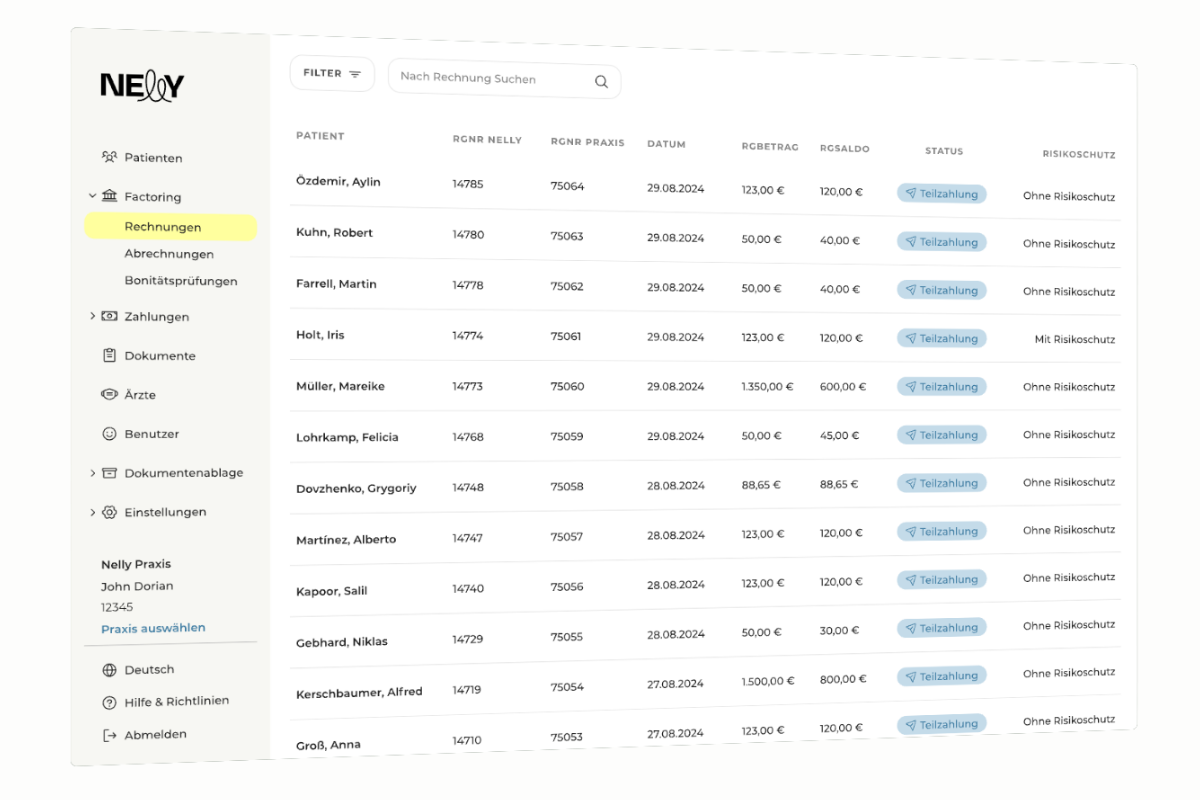
The short answer: A financial operating system like Nelly not only optimizes billing, but also the entire financial flow of your practice. Instead of introducing factoring in isolation, connect with Nelly digital patient recording, private billing, KV/KZV factoring, online payment, reminders, Expense management and reporting in a complete system.
Nelly digitizes and automates administrative tasks so that your team has more time to care for patients. The solutions integrate with existing practice management systems and support patients from initial contact to full payment.
How does Nelly's digital factoring work?
Nelly enables factoring in cooperation with banks as your contractual partner, provides the digital infrastructure, automates processes and ensures seamless workflows — the banks take over the financing and bear the risk contractually.
Important components:
- Digital invoicing: Invoices are generated automatically, sent digitally or by post, and patients can easily pay them online.
- Instant payout: Nelly pays out the majority of the invoice amount very quickly after submission — your liquidity remains stable.
- Real-time overview in the financial cockpit: Open and paid receivables, feedback on creditworthiness and invoice status, automatic reports for accounting and tax advice are available in real time.
- Outsourcing of dunning and risk: Depending on the model, the financial partner assumes the risk of payment defaults and the collection of reminders.
As a digital specialist in healthcare, Nelly has tailored the financial operating system exactly to the needs of doctors and dentists, for a consistent digital process.
Would you like to know all the benefits for your practice? Take advantage of a non-binding consultation.
How does KV/KZV factoring via Nelly support your practice?
In addition to private liquidation, settlement with associations of Statutory Health Insurance Physicians (KV) and Associations of Statutory Health Insurance Dentists (KZV) plays a central role. Nelly offers her own for this KV/ KZV factoring product , also in cooperation with banks as a contractual partner. This creates additional liquidity benefits for your practice.
What role do data protection and patient acceptance play?
Trust is crucial when it comes to digital financial solutions in medicine. It is important to differentiate: When billing health insurance services, Nelly does not process any patient data. Private factoring is different — this is where billing-relevant patient data is processed.
Accordingly, Nelly attaches great importance to data protection: The solutions are GDPR-compliant, TÜV-tested, and data is encrypted and stored on servers in Germany.
Key points for your patient communication in the case of private factoring:
- Transparency towards patients: Explain openly why you use digital processes and factoring: more time for treatment, clear invoices, flexible payment methods.
- Consideration of older patients: Many older patients have been accustomed to QR codes and digital processes since the corona period. If you don't want that, you can still use paper routes.
- Clearly present security arguments: Encrypted transmission, German servers, proven procedures, this high level of security alleviates concerns and strengthens trust.
conclusion
An honest look at your status quo is recommended for your decision-making:
- How much time do billing, reminders and inquiries take in your practice every week?
- How high are your outstanding amounts?
- How tight is your liquidity?
- How digital are your processes really, from patient admission to payment?
Self-billing remains a viable option, especially if your practice is rather small, well-organized and low-risk. Factoring in medical practices is now the standard for many practices in order to secure liquidity, eliminate default risks and relieve the administrative burden on the team.
A financial operating system such as Nelly goes even further with a high degree of digitization, from factoring including KV/KZV factoring to expenditure management and structured reports.
Get information now without obligation.
With Nelly as your financial operating system, you can focus again on what's most important: caring for your patients. Find out more now and make an appointment for an individual consultation.