Key takeaways:
- Applications: Automated appointment scheduling, phone assistants, documentation, and image analysis relieve the burden on practice staff.
- Opportunities: More time for patients, faster processes, more precise diagnoses thanks to data analysis.
- Risks: Data privacy issues, technological dependence, and misdiagnoses if used incorrectly.
- Prerequisites: Strict data protection, digital literacy, and clear responsibilities are mandatory.
- Role of AI: Complements medical expertise – but does not replace it.
Role of AI: Complements medical expertise – but does not replace it.
AI is primarily used in medical practices to automate routine tasks and to ease the workload of the practice team. This frees up more time for patient care.
Typical examples include appointment management, call handling, as well as the analysis of medical images or support for diagnoses.
AI does not replace the doctor, but rather complements their work through pattern recognition and decision-making aids.
But only those who understand the opportunities and risks will benefit from the "silent" revolution in 2026 – instead of being swept away by it.
Key applications of AI in medical practice

1. Practice Organization and Administration
Efficient processes are the backbone of every medical practice. Various AI solutions can help automate time-consuming administrative tasks and significantly relieve the burden on the practice team.
Areas of application:
AI-powered phone assistants: handle calls, record requests such as prescriptions or appointment requests, and automatically organize appointments.
However, such systems can still encounter limitations: they cannot always reliably understand dialects, background noise, or complex requests. Nevertheless, they save the practice team time because many routine calls are processed automatically.
Administrative support: for documentation, time tracking, and routine tasks to make workflows more efficient.
For example, they suggest wording for doctor's letters, handle routine entries, or automatically remind about missing information. They are not yet completely error-free – but even small automations save time and reduce tedious paperwork.
2. Diagnostic Support
Artificial intelligence is increasingly supporting doctors in making diagnoses.
It provides rapid evaluations and complements medical expertise with precise data analyses
Areas of application:
- Medical image analysis: Evaluation of X-ray and MRI images for the detection of diseases such as lung cancer or strokes.
- Symptom matching: Comparison of patient symptoms with known disease patterns to support medical diagnosis.
3. Data Analysis and Research
By analyzing large amounts of data, AI can recognize patterns and make predictions that support doctors in their decisions and improve care in the long term.
Areas of application:
- Pattern recognition in billing data: Analysis of billing information to optimize healthcare provision.
- Forecasting health risks: Data-driven prediction of potential illnesses for preventive measures.
4. Patient Interaction
AI systems improve the interaction between the practice and patients, by providing information and automatically answering frequent inquiries. This relieves the practice team and patients receive the necessary information more quickly.
Areas of application:
- Automated patient inquiries: AI answers common questions about opening hours or practice procedures.
- Digital patient support: Provision of relevant information and assistance for patients.
First systems like the AI documentation from Nelly can already record and automatically transcribe doctor-patient conversations. This simplifies background documentation and creates more room for direct interaction.
Key considerations for using AI in medical practices

1. AI relieves staff, but does not replace them
Artificial intelligence takes over routine tasks and gives practice teams more time for patient care. Nevertheless, human expertise remains irreplaceable: AI supports, but does not decide alone.
However, it is also clear: Medical diagnosis and the final decision on therapies remain in human hands. AI provides data, analyses, and suggestions, but it does not assume responsibility.
Thus, it remains a tool, not a replacement for medical professionals.
2. Data Privacy in AI Use in Medical Practice
When using AI, the protection of sensitive patient data is of central importance. Every practice must ensure that systems comply with GDPR requirements and that data is processed only encrypted and with clear access rights.
Transparency also plays a major role: Patients should always be able to understand what data is being used and for what purpose. Only then can trust in new technologies be built.
3. Digital Literacy with AI in Medical Practice
New technologies are only as good as the people who operate them. For AI applications to be used effectively, doctors and the practice team need a solid understanding of how they work.
Training and further education help to reduce reservations and ensure the smooth integration of AI into daily practice. Those who understand the opportunities and limitations of the technology can use it purposefully – and realistically assess its risks.
New AI Solutions for Documentation and Billing in Dental Practices
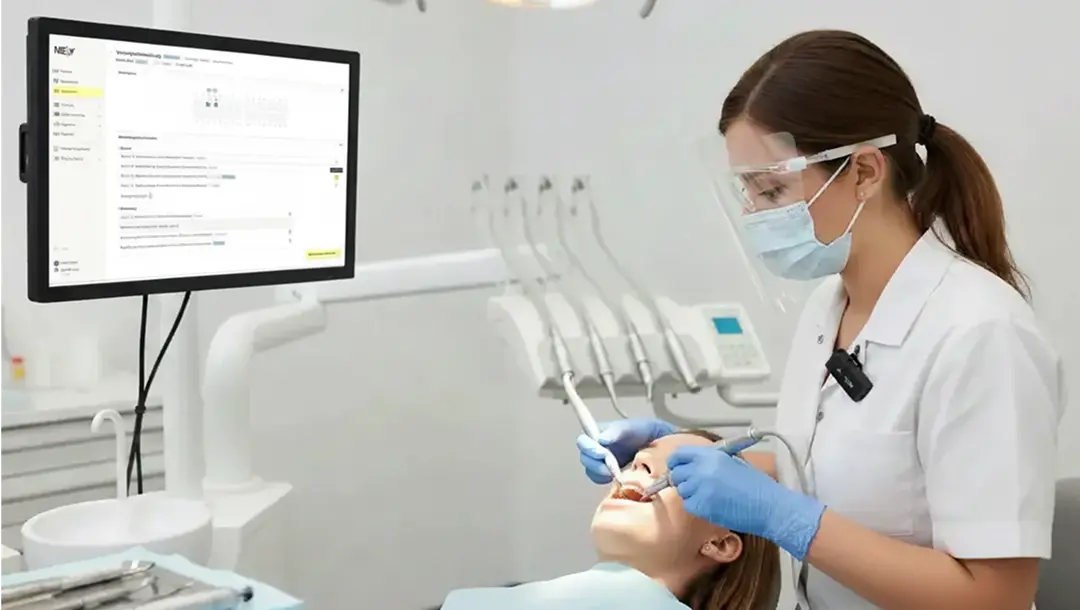
Nelly automates documentation in dental practices with AI.
Treatment discussions are directly recorded, structured, documented, and billing codes are automatically suggested – seamlessly integrated into daily practice.
This saves you time, reduces typical sources of error, and ensures: Only what is documented gets billed.
At the same time, you relieve your team during staff shortages – dental assistant time is freed up for more important patient-related tasks.
The solution integrates directly into existing practice systems and complements Nelly factoring effectively: Billing comes before Factoring – together creating a continuous, efficient workflow.
Would you like to try out Nelly AI Documentation yourself?
Test it for free on our website now.
Core Functions
1. Speech-to-Text Documentation:
Treatment discussions are recorded in real-time via speech and automatically documented in a structured way. Relevant medical content is filtered and can be reviewed before final storage.
2. AI-powered Service Coding:
Based on the documentation, the AI generates appropriate billing codes for BEMA and GOZ (incl. GOÄ) – plausible, traceable, and with final review by your team.
3. Billing Processes:
Nelly factoring ensures faster billing and improved liquidity.
Who is it particularly suitable for?
- Practices without their own billing staff ("Self-Billing")
- Practices that want to specifically relieve their billing staff
- Teams facing a skilled labor shortage who want to focus dental assistant resources more on treatment and patient care
- Dentists who want to significantly reduce administrative effort and billing errors
What does this mean for your daily practice operations?
- More treatment time, less bureaucracy
- More complete billing and fewer revenue losses
- Higher operational reliability in case of illness or staff turnover
What makes Nelly's Documentation AI special?
Learning System: Corrections and adjustments are directly incorporated into the system. This creates an individually trained assistant that continuously adapts to your practice and becomes increasingly precise.
For more information and details, please contact us here. We offer a no-obligation consultation.
Frequently Asked Questions
What should a good AI phone assistant achieve in a practice?
A good AI phone assistant must be able to answer calls automatically, understand callers' concerns, and record them correctly. Furthermore, it should be able to schedule appointments independently and reliably forward more complex cases to the practice team.
What should a good AI answering service achieve in a practice?
A good AI answering service must be able to reliably answer incoming calls, provide callers with standard information such as opening hours, and securely document important messages so they can be processed quickly by the practice team.
How many doctors use AI in medicine?
Currently, relatively few doctors in Germany use AI solutions in practice, especially in specialized areas like radiology. Nevertheless, surveysshow that interest is growing rapidly, and significantly more practices intend to adopt AI in the coming years.
Who needs to complete AI training?
All practice staff who work with AI systems must complete AI training. This includes doctors and administrative personnel, so they can safely operate the technology and understand its capabilities and limitations.
What are the disadvantages of AI in medicine?
AI in medicine can entail disadvantages if data protection regulations are not observed or if the technology malfunctions. Additionally, there is a risk of misdiagnoses with improper use, high implementation costs, and problems due to a lack of digital competence within the practice team.
Will doctors be replaced by AI?
No, doctors will not be replaced by AI. Artificial intelligence can analyze medical data, recognize patterns, and assist with diagnoses or organizational tasks. However, the responsibility for diagnosis, therapy, and patient care remains with the doctor. AI is a tool that makes processes more efficient and relieves doctors – but it replaces neither medical expertise nor personal patient contact.
Can AI make diagnoses like a doctor?
AI can assist with diagnosis by evaluating large amounts of data and identifying anomalies, for example, in medical images or patient data. It can provide clues and suggest possible diagnoses, but it does not replace medical judgment. The final diagnosis and treatment decision is always made by the doctor.
How are AI chatbots used in medical practices?
AI chatbots are used in medical practices to automatically answer recurring patient inquiries and support administrative processes. For example, they can clarify questions about opening hours, prepare appointments, or provide initial information about symptoms. This relieves the practice team, and patients receive faster feedback. However, direct contact with a doctor is still required for medical diagnoses or individual treatments.
How does AI improve medical care?
AI can improve medical care by accelerating processes and supporting doctors in decision-making. It helps to evaluate large amounts of data, identify anomalies early, and automate administrative tasks. This leaves more time for actual patient care. At the same time, AI can help support diagnoses and make treatment processes more efficient – provided it is used responsibly and supervised by medical professionals.