
Who is allowed to set up a dental practice?
The establishment of a dental practice in Germany is subject to clear professional requirements.
It is absolutely necessary to Approval as a dentist. It forms the legal basis for every self-employed activity.
Anyone who wants to treat legally insured patients and bill them with health insurance companies also needs the Approval as a contract dentist. This requires registration in the dental register with the responsible Association of Statutory Health Insurance Dentists.
Registration in the dental register usually requires at least two years of preparation as an employed dentist or assistant dentist.
How much revenue does a dental practice make per month?
The monthly turnover of a dental practice varies greatly depending on location, size and private share. A classic individual practice can be approximately between 40,000 and 60,000 euros per month attain. Larger or specialized practices may be significantly higher.
It is important to differentiate between turnover and profit. Turnover must cover personnel, material, rental and financing costs, among other things.
How much actually remains with the practice owner in the end depends largely on workload, cost structure and organization.
Starting a dental practice: Build a new one or take over an existing practice?
Anyone who wants to set up a dental practice must decide whether to restart or take over an existing practice.
Both paths lead to self-employment, but differ significantly in terms of capital requirements, risk and scope for manoeuvre.
Setting up a new dental practice
A start-up offers maximum freedom of design. Location, room concept, equipment and positioning can be strategically planned right from the start. Processes can also be set up directly in a modern and digital way.
However, this is offset by higher initial investments. In addition, lower capacity utilization must be expected in the initial phase, so that sufficient liquidity reserves are crucial.
According to an analysis by Deutsche Apotheker- und Ärztebank In 2023, the average financing volume for a complete start-up was 770,000 euros.
Practice takeover
The takeover of an existing individual practice is usually easier to plan than setting up a new one. An existing patient base, an experienced team and ongoing sales reduce the economic risk in the start-up phase.
On the other hand, there is less freedom of design and possible modernization costs. Location, reputation and structures have already been defined.
According to the same ApoBank analysis, the average investment volume for taking over an individual practice in 2023 was around 463,000 euros. The actual purchase price depends heavily on the location and level of turnover.
More information about The topic of practice takeover can be found here.
What is more worthwhile?
Economically, a takeover is often more predictable, while the start-up offers more strategic freedom in the long term. The right choice depends on location, capital base, personal risk profile and business goals.
The costs of setting up a dental practice at a glance
The total costs of setting up a practice consist of one-time investments and ongoing operating costs. While a start-up involves high initial investments, there are permanent fixed costs after the opening, which must be taken into account in liquidity planning.
The costs of setting up a new company
A complete start-up involves the following investments in particular:
- Practice rooms and renovation: Rental expansion, structural adjustments, electrical systems, water connections, hygiene concepts.
- Medical technology and equipment: treatment units, X-ray equipment, sterilization systems, IT infrastructure.
- Furnishing and furniture: Reception, waiting rooms, social rooms.
- Planning, advice and approvals: Architect, specialist planner, legal advice.
- Working capital and liquidity reserve: Reserves for the start-up phase.
Current costs after incorporation
After opening, there are fixed monthly costs, which must be covered regardless of turnover:
- personnel costs
- Rent or loan installment
- Material and laboratory costs
- Insurance and contributions
- IT, software and maintenance
- Tax advice and administration
The largest cost block is usually personnel costs, followed by material and laboratory costs. Depending on the location and investment amount, room costs or financing rates represent further significant fixed costs.
How high the total costs are in relation to turnover depends heavily on practice size, team structure and mix of services. Realistic liquidity planning is therefore crucial for economic stability.
Financing and business plan for the dental practice

Financing is one of the decisive factors when setting up a practice. Banks not only check the investment amount, but above all the economic viability of the project. The basis for this is a robust business plan.
Equity and external financing
A dental practice is usually financed through a combination of equity and bank loans. In many cases, a Equity ratio of around 10 to 20 percent recommended. However, the actual requirements depend on the bank, credit rating and funding structure.
The terms of practice loans are often in the range of 10 or more years, depending on the financing model and funding program.
In addition, a Liquidity reserve for several months of fixed costs be planned because capacity utilization is often not yet stable at the beginning.
Content of a business plan
A professional business plan should include:
- Location analysis and competitive situation
- Description of the range of services
- Investment and financing plan
- realistic sales and cost forecast
- Liquidity planning for at least the first three years
It is crucial that the assumptions are comprehensible and realistic. In particular, banks are examining whether turnover forecasts fit the regional market situation and whether the practice can support loan installments over the long term.
Funding opportunities
Coming for founders KfW funding programs as well as regional promotional banks. ERP start-up loans or promotional loans for practice takeovers are particularly relevant. Which programs are specifically suitable depends on the federal state and financing concept.
5 steps to your own dental practice
The path to self-employment can be divided into 5 central phases. Many steps run in parallel, yet this structure helps with planning.
1. Define strategy and positioning
At the beginning, there is the basic orientation of practice. This does not necessarily mean specialization, but clarity about how practice should work economically.
Among other things, the following must be clarified:
- Practice profile: classic general dental practice or with clear focal areas such as implantology, prosthetics or aesthetic services
- Target group: families, private patients, elderly patients, rural primary care or mixed urban structure
- Location strategy: High-frequency inner-city location, medical center, residential area or underserved rural area
- Growth planning: langfristig Einzelbehandler bleiben oder Ausbau mit angestellten Zahnärzten
Diese Entscheidungen beeinflussen Investitionshöhe, Raumgröße, Personalbedarf und Marketing. Wer hier unscharf plant, zahlt später potenziell stärker drauf.
2. Rechtsform wählen und Zulassung sichern
Nun werden die rechtlichen Grundlagen geschaffen. Dabei geht es mitunter um Haftung, steuerliche Belastung und spätere Erweiterungsmöglichkeiten.
Zu klären sind:
- Rechtsform: Einzelpraxis (volle Kontrolle, volle Haftung), Berufsausübungsgemeinschaft oder Partnerschaftsgesellschaft (geteiltes Risiko, gemeinsame Verantwortung)
- Haftung und Steuerstruktur: Wie werden Gewinne verteilt? Wer haftet bei Behandlungsfehlern oder wirtschaftlichen Problemen?
- Zulassung als Vertragszahnarzt, sofern gesetzlich Versicherte behandelt werden sollen.
- Eintragung ins Zahnarztregister bei der zuständigen Kassenzahnärztlichen Vereinigung.
Gerade bei Kooperationen sollten Gesellschaftsvertrag, Entscheidungsbefugnisse und Gewinnverteilung klar geregelt sein. Fehler in dieser Phase wirken oft langfristig nach.
Auf Basis des Businessplans werden konkrete Finanzierungsentscheidungen getroffen.
Dazu gehören:
- Eigenkapitalhöhe festlegen
- Bankdarlehen verhandeln
- Förderprogramme prüfen
- Tilgungsstruktur und Laufzeit abstimmen
- Liquiditätsreserve für die Anlaufphase einplanen
Wichtig ist eine realistische Planung. Zu optimistische Umsatzannahmen können später zu Problemen führen.
4. Räume planen und Ausstattung beschaffen
Jetzt wird aus dem Konzept eine funktionierende Praxis.
Zu berücksichtigen sind:
- Anzahl der Behandlungszimmer und mögliche Erweiterungsoptionen
- Hygienekonzepte und gesetzliche Anforderungen
- Auswahl der Medizintechnik
- IT-Infrastruktur und Praxissoftware
- Zeitplanung für Umbau oder Übergabe
Eine vorausschauende Planung verhindert spätere teure Umrüstungen.
5. Team aufbauen und Patienten gewinnen
Parallel zur Bau- oder Übergabephase beginnt der organisatorische Aufbau.
Wichtige Punkte sind:
- Einstellung von ZFA und ggf. angestellten Zahnärzten
- Definition klarer Abläufe und Verantwortlichkeiten
- Aufbau der Online-Sichtbarkeit (Website, Google-Unternehmensprofil und je nach Möglichkeit Social Media)
- Lokale Vernetzung und Empfehlungsmarketing
Ziel ist eine stabile Auslastung möglichst früh nach der Eröffnung.
Praktische Checkliste für die Gründung der Zahnarztpraxis

Die folgende Übersicht hilft, die wichtigsten Schritte strukturiert abzuarbeiten:
1. Rechtliches und Zulassung
- Approbation prüfen
- Vorbereitungszeit (mind. 2 Jahre) nachweisen
- Eintragung ins Zahnarztregister beantragen
- Kassenzulassung beantragen (falls GKV-Patienten geplant sind)
- Mitgliedschaft in der zuständigen Zahnärztekammer klären
- Rechtsform festlegen
- Gesellschaftsvertrag prüfen oder erstellen lassen
- Berufshaftpflichtversicherung abschließen
- Röntgengenehmigung bzw. Anzeige bei der zuständigen Behörde klären
2. Finanzierung und Planung
- Businessplan finalisieren
- Eigenkapital festlegen
- Finanzierungsgespräche führen
- Förderprogramme prüfen
- Liquiditätsreserve kalkulieren
3. Standort und Räume
- Mietvertrag oder Kaufvertrag prüfen
- Umbau- und Raumkonzept planen
- Hygienekonzept abstimmen
- Genehmigungen einholen
- Bau- und Lieferzeiten abstimmen
4. Technik und Ausstattung
- Behandlungseinheiten auswählen
- Röntgentechnik planen
- IT und Praxissoftware auswählen
- Wartungsverträge prüfen
5. Organisation und Team
- Mitarbeiter einstellen
- Arbeitsverträge vorbereiten
- Praxisabläufe definieren
- Versicherungen abschließen
6. Marketing und Sichtbarkeit
- Praxisname festlegen
- Website erstellen
- Google-Unternehmensprofil einrichten
- Lokale Sichtbarkeit aufbauen
Zahnarztpraxis von Anfang an digitalisieren mit Nelly
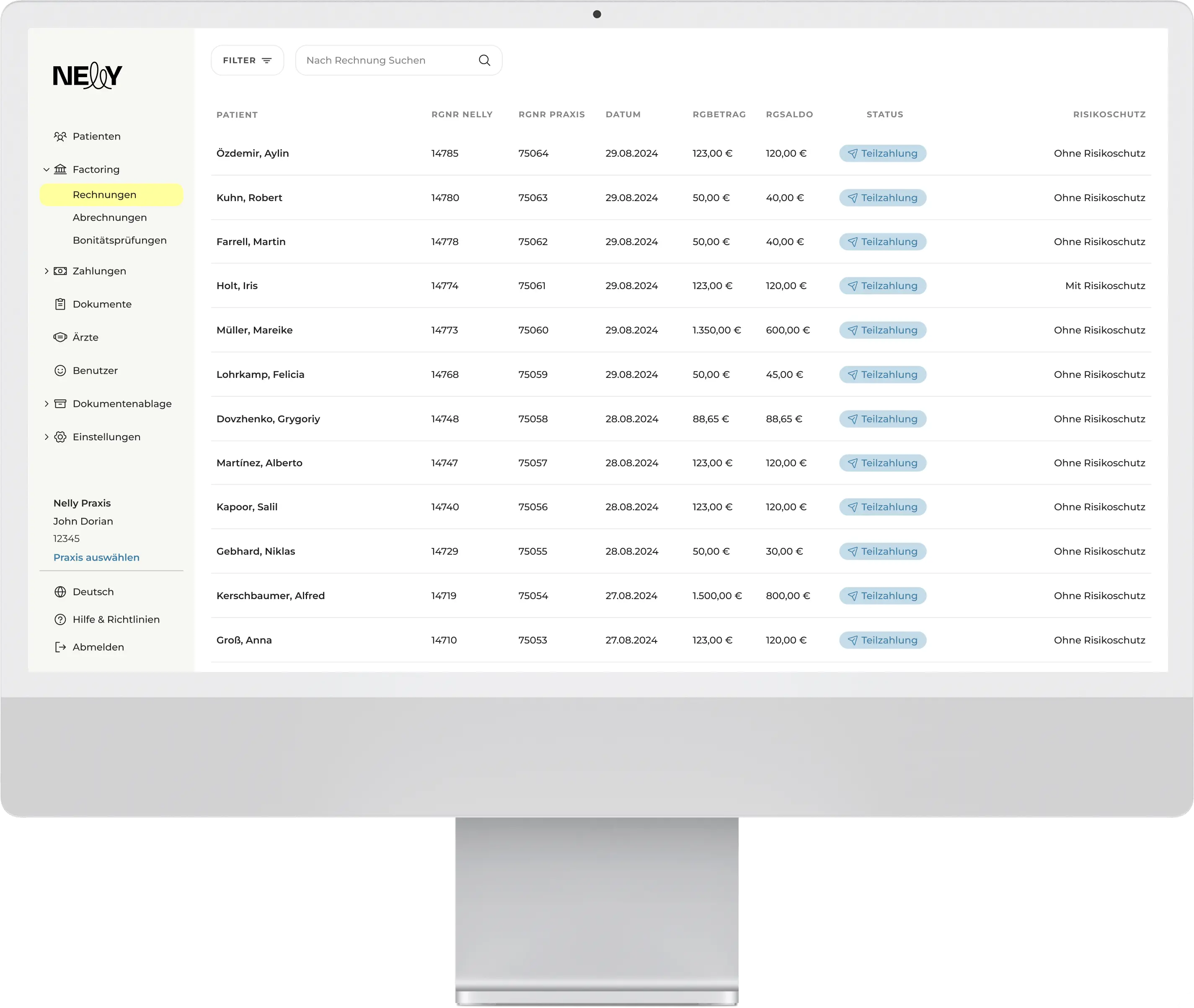
Wer heute eine Zahnarztpraxis gründet, sollte Prozesse nicht erst analog aufbauen, um sie später aufwändig zu digitalisieren. Mit Nelly lassen sich zentrale Abläufe von Beginn an strukturiert digital aufsetzen.
Was Nelly für Sie je nach Bedarf abdecken kann:
- Digitale Anamnese und Patientenaufnahme
- Digitale Dokumente und rechtssichere Unterschriften
- Behandlungsdokumentation mithilfe von KI
- Automatisierte Patientenkommunikation
- Digitale Rechnungs- und Zahlungsprozesse wie Factoring
- und mehr
Statt Papier, Medienbrüchen und manueller Nacharbeit entstehen klare, effiziente Prozesse – skalierbar vom ersten Behandlungstag an. Wie das in der Zahnarztpraxis Drehbahn 7 konkret umgesetzt wurde, erfahren Sie in unserem Kurzbericht.
Lassen Sie sich zeigen, wie Sie Ihre Zahnarztpraxis von Anfang an digital aufsetzen und administrative Abläufe nachhaltig vereinfachen können. Wir beraten Sie gerne unverbindlich.
Common questions
Is there a shortage of dentists in Germany?
There is currently no nationwide shortage of dentists across Germany. The total number of licensed dentists is stable. However, there are regional differences: In rural regions and structurally weak areas, refilling practices can be more difficult, while there is often a high density of dentists in metropolitan areas. The decisive factor is therefore not so much the nationwide figure as the regional supply situation. For entrepreneurs, an underserved region can be strategically attractive.
What does a dentist earn the most from?
Revenue depends heavily on the range of services. As a rule, the following are particularly economical:
- implantology
- high quality dentures
- aesthetic treatments
- private medical services
The share of privately paid benefits significantly influences the profitability of a practice. At the same time, capacity utilization, efficient processes and a clear positioning are also crucial.
How much does a dentist with his own practice earn per month?
The income of a self-employed dentist depends on turnover, cost structure and practice size. The profit after deducting all running costs is decisive. For economically stable individual practices, the monthly owner income can be in the mid-five-digit range — even below or significantly higher, depending on workload and structure.